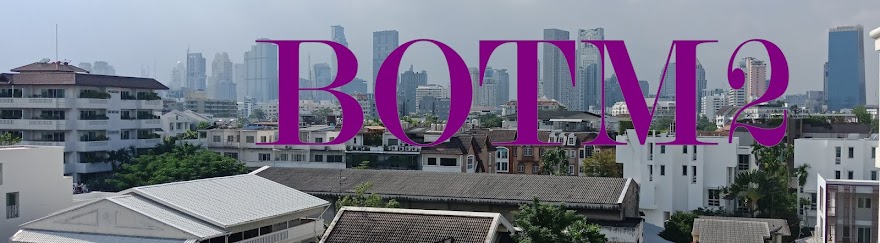
We’re shut up in our own home, like rats in a hole. How else to keep out the construction noise from the condo next door?
The workmen shoo-ed away by one of my neighbours on Friday are back, drilling, and bashing away with a sledgehammer.
My hot-tempered neighbour told them to go, as he was tired of their noise. Today he is away, or perhaps has decided he has no choice but to let them get on with their work, for I have heard nothing further from him.
I have closed the sliding doors on the balcony, and the windows against the noise and the dust.
The owner of the building next door did not bother to tell his neighbours that he was hiring a gang to refurbish it.
Thais assume everyone will just put up with noise and inconvenience. We find out when the labourers arrive, and have to tolerate their presence until the work is finished, which could take weeks.
The same care-free attitude explains why we also put up with young men charging through the condo precinct on souped-up motorbikes, just for a lark; or why in our high-value neighbourhood we also tolerate packs of stray dogs inter-breeding, fighting and howling at all hours.
When Maiyuu peddles his bicycle to the market, he is chased by dogs snapping at his heels. The mutts live and breed on vacant plots of land, though a few also have taken up guard duty at the entry and exit to this condo.
When I walk home at night, the dogs bark, as the place is in darkness, and humans aren’t supposed to be out at that hour.
Last night, half a dozen mongrels were fighting each other on the road I take home. I am grateful they let me pass.
Thailand is a laid-back place, so noisy labourers, teenagers and dogs are part of the deal.
As I walk home, I also pass a block of slum housing, opposite a school. A young man who lives there likes to wander about on the road outside. He wears nothing but boxers.
When I come across him, he is talking on his cellphone. Presumably he has come out to get some privacy.
The other night he had taken off the boxers, and was wearing just a pair of briefs.
He sees me pass each night, but doesn’t seem to mind that I witness him in such a state.
Young men in a state of near-undress who don’t care what other people think are another part of what makes this place Thai.
Such scenes of near-naked abandonment would be hard to find in my buttoned-down neighbourhood in the West. All in all, I’d rather still be here.
Monday, 21 September 2009
Sunday, 20 September 2009
Fiery Thai, tackling biker noise
"Stop that noise this minute!’ a Thai man yelled.
Sitting at my computer, I heard the noise come through my window, and sat up with a start.
I hardly ever hear Thais around hear raise their voices.
It was almost 5pm last Friday, and a Thai living in my condo had obviously had enough noise for one day.
His target was a group of labourers, demolishing part of a condo next to us (see picture). In the several weeks they have been working there, the noise levels have grown steadily worse.
The labourers promptly stopped work. No one stood up to the man who lost his temper. I barely heard a peep from the labourers as they packed their tools for the day and left.
-
I would like to borrow the services of the hot-headed man, should I ever identify him, to tackle another noise problem around here.
A teenager who lives in the slum section nearby races through the precincts of this condo on his motorbike many times a day.
His motorcycle is fitted with one of those noisy exhausts which teens love. He passes through this condo on his way to the main road.
It is a convenient shortcut, and the security guards obligingly lift the barrier arm at the entrance and exit to the place whenever he approaches, to let him through.
‘Why do you lift the barrier?' I asked one security guard the other day.
'That young man races through this place at all hours of the night, just for fun. He wakes up residents, and doesn’t even live here,’ I said.
Aged in his 60s, the guard speaks softly, with his head bowed so I can barely hear what he says. ‘If I don’t lift the barrier, I am afraid he will come back with his mates from the neighbourhood in the middle of the night and beat me up,’ he said sadly.
I will have to fix this problem, I told myself. I could tell the condo office that they are employing a security guard who is too timid to do his job, but that would be mean.
I could try finding the hot-tempered Thai man in my condo building, to ask him if he’s as annoyed as I am by the young man with the noisy bike.
Or perhaps I could try tracking down the lad himself, or his parents. I know where he ‘hangs’, as young people like to say. Shall I risk it?
Wednesday, 16 September 2009
Where do old scent bottles go?
Maiyuu found on the internet a trader wanting to buy empty bottles of imported scent.
He polished a collection of empty bottles, then took them in to see the man. The price paid by the trader varied according to the brand, or make of perfume. From 15 bottles, he made the impressive sum of B700.
The biggest return from any one bottle was B200, for Calvin Klein’s ckin2u.
The trader also offered B100 each for three or four other popular scents; B50 each for two others; B100 for a handful of lesser-known brands, plus B5 each for two bottles which the trader didn’t want but paid him for anyway.
He polished a collection of empty bottles, then took them in to see the man. The price paid by the trader varied according to the brand, or make of perfume. From 15 bottles, he made the impressive sum of B700.
The biggest return from any one bottle was B200, for Calvin Klein’s ckin2u.
The trader also offered B100 each for three or four other popular scents; B50 each for two others; B100 for a handful of lesser-known brands, plus B5 each for two bottles which the trader didn’t want but paid him for anyway.
Maiyuu did not ask him what he intends to do with the bottles, but we might be able to guess.
‘He might buy a small bottle of the original scent, in the form of oil, and mix it with alcohol,’ says Maiyuu. 'He will sell the scent, packaged as the original but at a cheaper price, in the bottles he bought from me.'
The trader wll probably sell his scent, in the bottles he obtained originally from Maiyuu, at Klong Thom market near Chinatown.
The trader also buys in used printer cartridges (is there a market for knock-off printer ink?), used CDs, and old currency, among other items.
Where do we get them from? Maiyuu buys scent in bulk from a gay friend, who gets it from the perfume counter of a city department store, where he is on good terms with a couple of staff. Pictured are some of the bottles in Maiyuu's collection.
We buy the real thing, mainly in the standard size available at any store, though we also have a few bottles of scent in tester size.
Airline stewards, who get them from the manufacturer, offer testers to traders, who sell them on to the public.
‘The guy who bought my bottles asked me if I had any Polo Black. I do, but it is in tester size, which is too small for his needs,’ said Maiyuu, showing me his stubby-looking bottle of Polo Black.
Under pressure from the US to enforce intellectual copyright law, the government launches occasional crackdowns on pirated and counterfeit goods, such as imported CDs, clothes and scent. Police raid stalls offering the goods in tourist centres such as Silom.
I wonder if they also tackle the problem at source, such as traders who buy empty bottles to refill with knock-off scent, or second-hand CDs which they slip back into a new CD cover to make them look new?
‘He might buy a small bottle of the original scent, in the form of oil, and mix it with alcohol,’ says Maiyuu. 'He will sell the scent, packaged as the original but at a cheaper price, in the bottles he bought from me.'
The trader wll probably sell his scent, in the bottles he obtained originally from Maiyuu, at Klong Thom market near Chinatown.
The trader also buys in used printer cartridges (is there a market for knock-off printer ink?), used CDs, and old currency, among other items.
Where do we get them from? Maiyuu buys scent in bulk from a gay friend, who gets it from the perfume counter of a city department store, where he is on good terms with a couple of staff. Pictured are some of the bottles in Maiyuu's collection.
We buy the real thing, mainly in the standard size available at any store, though we also have a few bottles of scent in tester size.
Airline stewards, who get them from the manufacturer, offer testers to traders, who sell them on to the public.
‘The guy who bought my bottles asked me if I had any Polo Black. I do, but it is in tester size, which is too small for his needs,’ said Maiyuu, showing me his stubby-looking bottle of Polo Black.
Under pressure from the US to enforce intellectual copyright law, the government launches occasional crackdowns on pirated and counterfeit goods, such as imported CDs, clothes and scent. Police raid stalls offering the goods in tourist centres such as Silom.
I wonder if they also tackle the problem at source, such as traders who buy empty bottles to refill with knock-off scent, or second-hand CDs which they slip back into a new CD cover to make them look new?
Monday, 14 September 2009
Tabloid trash, rich girl's sneer, red rally
‘Jacko’s last wish! Secret notes found in tragic star’s home...’
Farang C took me to Molly Malone’s Irish pub in Soi Convent, which carries the latest copies of Irish and British newspapers.
That was the headline which one screamed at me from from the newspaper stack. I didn't see any newspapers in Thai.
Inside the pub, I saw only farang. A few were eating dishes from the menu.
A vendor was selling noodles from a right outside the front door.
About 6pm, as the skies clouded over and office-workers were heading home, I left the pub and sat down for a bowl.
Here on the street outside, I saw only Thais.
-
Farang C and I walked to Molly Malone’s from the top of the soi on Sathorn Rd, past BNH Hospital, and a couple of Christian schools. We passed Italian restaurants, bakery joints...
I like inspecting wealth. We saw plenty of it, and not just in the shops.
St Joseph’s Convent School was disgorging children to a queue of rich-family cars waiting outside.
Most of the children were pale-skinned Thai-Chinese. Little girls with tight bangs in their hair sneered at us, or at least I thought they did.
'Little bitches!'I exclaimed, for farang C's hearing.
'I haven't been here long enough to tell the difference between ordinary Thais and those with Chinese blood,' he replied.
I passed one father, who was talking to his daughter in Chinese.
This is the Bangkok elite, I thought. they would have little contact with their poorer countrymen from the provinces - many of whom move to Bangkok to earn a living, especially in the off-cropping season.
How many of these people speak to dark-skinned Thais from the provinces in the course of a day, unless they happen to employ one as the office cleaner?
-
One of those dark-skinned workers took me home in his taxi.
A father of five, he lives in Bangkok, but comes from Ubon Ratchathani, where he owns a farm. I shall call him Uncle.
Uncle, 55, has worked as a taxi driver in Bangkok for more than 30 years. His three sons live with him here, and they too ply the streets in taxis.
His daughters live in Ubon. One girl is a teacher, and the other one about to graduate from university. She wants to be a policewoman.
‘My sons weren’t academic, but the girls were,’ he said.
I asked him if he was proud to have fathered five children who are now successful young adults.
‘It’s just normal,’ he said.
His wife lives on the farm with one daughter, the teacher. Uncle gets home once every three months to plant or harvest rice.
‘When my other daughter graduates in a few months, I shall retire as a taxi driver, and return to the provinces full-time. I am tired of Bangkok,’ he said.
Uncle has driven rented taxis for a living since he was in his late teens. He is looking forward to a change.
Like many rural folk from the country’s North and Northeast, he supports former prime minister Thaksin Shinawatra.
‘He ran a government for the poor – the one we have now, Abhisit Vejjajiva, runs a government for the rich,’ he said.
We talked about prominent southerners who support the Abhisit-led government.
Abhisit may be a wealthy Bangkok boy, but his Democrat party is backed by southerners such as Deputy Prime Minister Suthep Thaugsuban (‘Abhisit’s boss’, sniffs Uncle) and Prem Tinsulanonda, head of the Privy Council. Most of the party's support base, in fact, is in Bangkok and the South.
‘Thais are still as divided as ever. When I was a boy, we had unity, but now we are split,’ he lamented.
This Saturday marks the third anniversary of the coup which ousted Thaksin.
The red-shirted United Front for Democracy against Dictatorship, which supports Thaksin, will mark the occasion with a rally. ‘I will be there, wearing red. I am from Esan [the Northeast], so I have to go,’ he said.
Talking heads
A few readers have sent me messages criticising my moderation policy on the blog. Some find it scary or intimidating to have their comments subject to scrutiny first.
I welcome hearing what readers have to say, as I think this blog is a much better place when readers respond to the posts.
However, I am not prepared to accept comments which are negative for the sake of it. Most unpleasant comments are written about Maiyuu, by people who know him only through this blog.
If those comments provoked debate among followers of this blog about Maiyuu's actions or my response, they wouldn’t be so bad; but most tend to ignore negative comments posted under the anonymous label, which raises the question of what they add to the blog or why I should bother publishing them.
As I have said before, I am constantly surprised at how unpleasant some readers can be. It is as if they have an axe to grind, or are bitter about their own experiences in Thailand and wish everyone else shared their misery.
Another factor which makes it difficult to lift the moderation bar is the amount of spam which this blog gets. I would rather stop the spam when it gets to my mailbox, not when it has already appeared on the blog, as no one wants to read spam either.
Having said all the above, most reader reaction – even the critical stuff – does get published. One anonymous critic posted unfavourably about Maiyuu the other day. I did not approve it straight away, but eventually it did go up.
I can’t help but noticing that when Maiyuu does something right, the anonymous critics who are so quick to savage him when he slips up stay remarkably quiet. I wonder why?
The next time one of Maiyuu's critics has something to say, perhaps he'd like to tell us why it should be published. What is the purpose it is trying to achieve?
I may well approve it anyway, but it will an interesting exercise in flushing out his own motives, should he be willing to oblige.
I welcome hearing what readers have to say, as I think this blog is a much better place when readers respond to the posts.
However, I am not prepared to accept comments which are negative for the sake of it. Most unpleasant comments are written about Maiyuu, by people who know him only through this blog.
If those comments provoked debate among followers of this blog about Maiyuu's actions or my response, they wouldn’t be so bad; but most tend to ignore negative comments posted under the anonymous label, which raises the question of what they add to the blog or why I should bother publishing them.
As I have said before, I am constantly surprised at how unpleasant some readers can be. It is as if they have an axe to grind, or are bitter about their own experiences in Thailand and wish everyone else shared their misery.
Another factor which makes it difficult to lift the moderation bar is the amount of spam which this blog gets. I would rather stop the spam when it gets to my mailbox, not when it has already appeared on the blog, as no one wants to read spam either.
Having said all the above, most reader reaction – even the critical stuff – does get published. One anonymous critic posted unfavourably about Maiyuu the other day. I did not approve it straight away, but eventually it did go up.
I can’t help but noticing that when Maiyuu does something right, the anonymous critics who are so quick to savage him when he slips up stay remarkably quiet. I wonder why?
The next time one of Maiyuu's critics has something to say, perhaps he'd like to tell us why it should be published. What is the purpose it is trying to achieve?
I may well approve it anyway, but it will an interesting exercise in flushing out his own motives, should he be willing to oblige.
Subscribe to:
Comments (Atom)